Background
Ghana is a politically stable, safe, and easily accessible English-speaking nation on the south-west coast of Africa, with a population of 33 million. While WEO President Prof. Aabakken has more than 20 years of engagement with and insight into Ghana’s medical landscape, an exploratory trip in January 2024 with Prof. Purnima Bhat revealed, at that time, an unclear training landscape split across multiple institutions. However, the institutional framework has since clarified. Thus, WEO successfully organized a standard-style training course hosted at the University of Ghana Medical Center (UGMC), drawing medical participants from across the city of Accra.
Tutors: Prof. Lars Aabakken, Dr. Dominic Mutura.
Hospital overview
The overall institutional landscape in Accra, described below, remains consistent with the previous report.
Korle-Bu Teaching Hospital: This facility serves as the primary academic hub responsible for training all certified gastroenterologists in the country. However, endoscopy facility growth remains limited. While case volumes and training quality are solid, there are no current prospects for major structural development, ERCP, or EUS. The existing Medical and Surgical Skills Institute (MSSI) training facility remains active but is heavily prioritized for surgical training.
Nova Surgical Center: This private surgical center operates within a refurbished section of a private Ob-Gyn hospital in central Accra, and was established via an initiative by Prof. Lewis Roberts, a Ghanaian hepatologist at the Mayo Clinic. It is outfitted with high-quality US equipment, including a fully-fledged ERCP unit with a dedicated new tower, a C-arm, and a well-inventoried accessory stockpile. The program is supported financially and operationally by a US-based group led by Prof. Roberts and offers approximately 1 week of ERCP training per month with visiting US faculty. Currently, ERCP procedures are performed exclusively by these visiting faculty members. Local trainee Dr. Akosua is undergoing intensive training. Two Japanese-trained consultants plan to join this program in the future.
University of Ghana Medical Center (UGMC): The University of Ghana’s medical college opened this hospital facility around seven years ago. At present, the endoscopy unit is underutilized and operated primarily by a single gastroenterologist, Dr. Amoako Duah, with occasional surgical support. The infrastructure is impressive, featuring great facilities that exceed baseline European benchmarks. The unit boasts two endoscopy rooms, the second recently upgraded with an Olympus X1 series tower. This setup is supported by premier nursing staff, excellent waiting areas, and a hospital-wide electronic medical records system, integrated with electronic reporting and endoscopic image storage software. UGMC operates on a combined private/public financial model where procedural and accessory costs are paid directly by the patient, exchanging affordability for a superior clinical ambience.
Training course
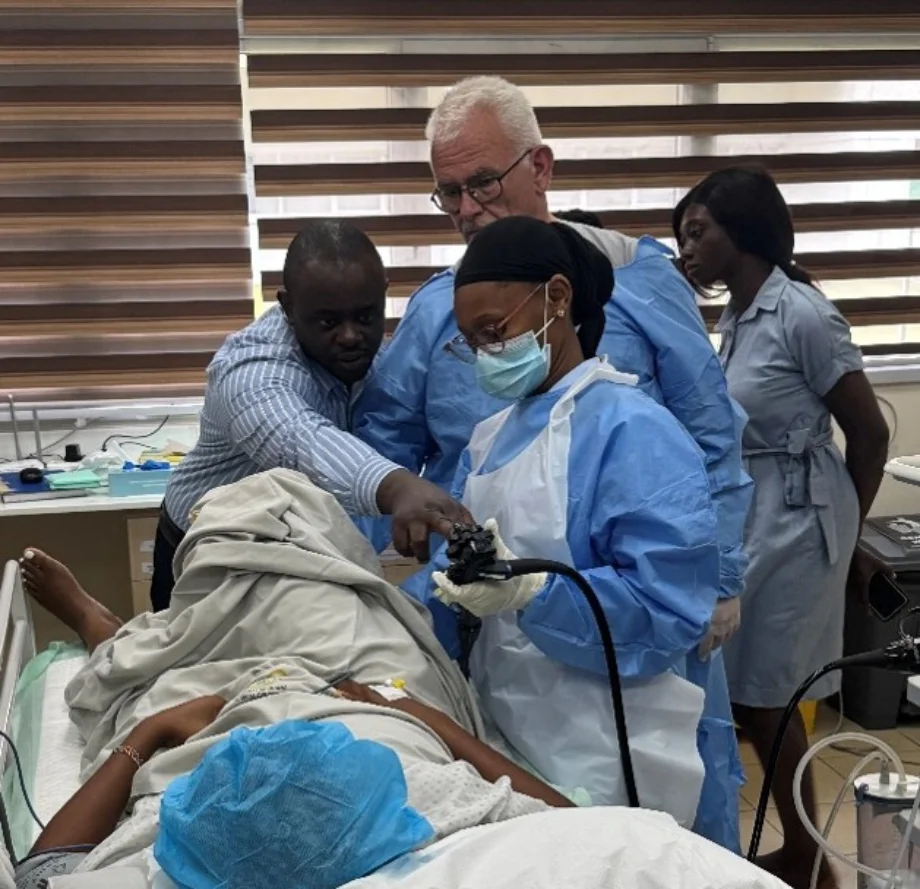
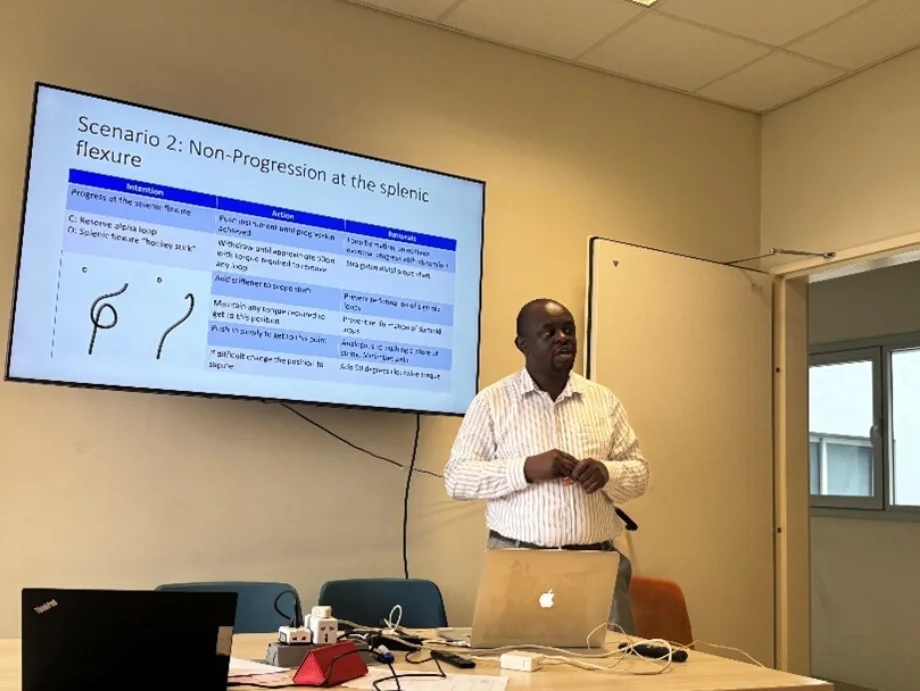
WEO conducted a highly interactive, 3-day training program structured around a cohesive group of roughly 15 fellows and 2–3 nurses. The schedule commenced daily at 08:00 with two theoretical lectures, followed by hands-on clinical courses finishing between 14:00 and 15:00. Clinical cases focused heavily on diagnostic upper endoscopies and colonoscopies, including one esophageal banding, and one scheduled dilation that was however canceled due to suspected eosinophilic esophagitis. Fellows performed all clinical procedures under the direct guidance of Dr. Duah and Dr. Akosua, supported by senior fellows. WEO faculty acted strictly in a meta-mentoring capacity, a distribution of labor highly praised by the local team. Trainees demonstrated moderate, safe baseline competence paired with exceptional receptivity to input. Micro-Tech, represented by Andreas Jung, served as a vital partner by supplying all necessary clinical accessories and delivering expert guidance on optimal product usage.
Innovation: Telementoring pilot
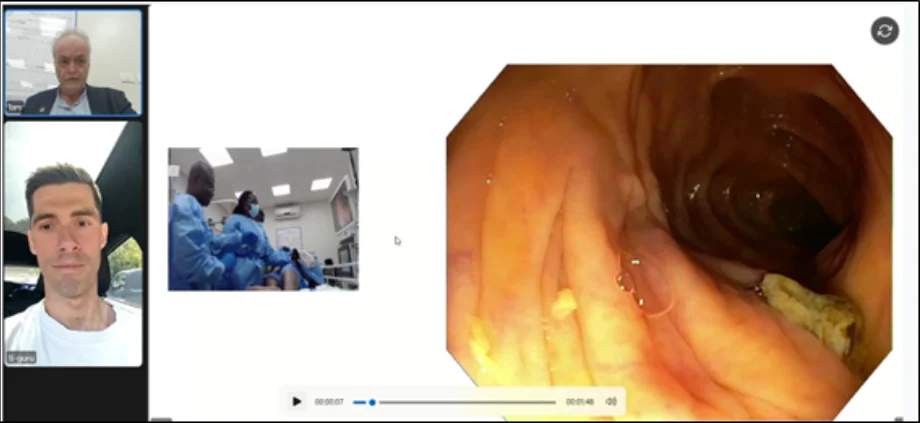
The course served as a successful field test for a developed version of Dr. Egeland’s telementoring platform. Despite localized bandwidth fluctuations, the system successfully maintained a connection with a medical center in Oslo, transmitting high-quality procedural images. The hardware will undergo final technical tweaks in Oslo and is expected to roll out globally across WEO centers as a standard training tool.
Conclusion
Accra’s geopolitical safety, infrastructure, and English-speaking landscape make it an ideal regional centerpiece for WEO training operations in West Africa. Establishing a permanent basic endoscopy training course at UGMC is highly logical development and mutually desired by WEO, the local Ghanaian team, and hospital executives. WEO faculty held a strategic meeting with the newly appointed UGMC CEO, Dr. Abdul-Samed Tanko, and Medical Director, Dr. Baffoe-Gyan. The leadership highly commended Dr. Duah's local GI endoscopy initiatives and applauded the impact of the WEO training course. The CEO expressed enthusiastic support for a long-term alliance and is actively awaiting a draft Memorandum of Understanding (MoU) to outline further collaboration.
A sincere thank you goes to co-mentor Dr. Dominic Mutura from Kenya. His clinical competence, advanced teaching skills, and deep understanding of the African healthcare landscape proved invaluable to the mission's success. WEO highly anticipates welcoming him as a permanent member of the WEO faculty network.
We thank Olympus and Micro-Tech for their great support in making this training program a success.