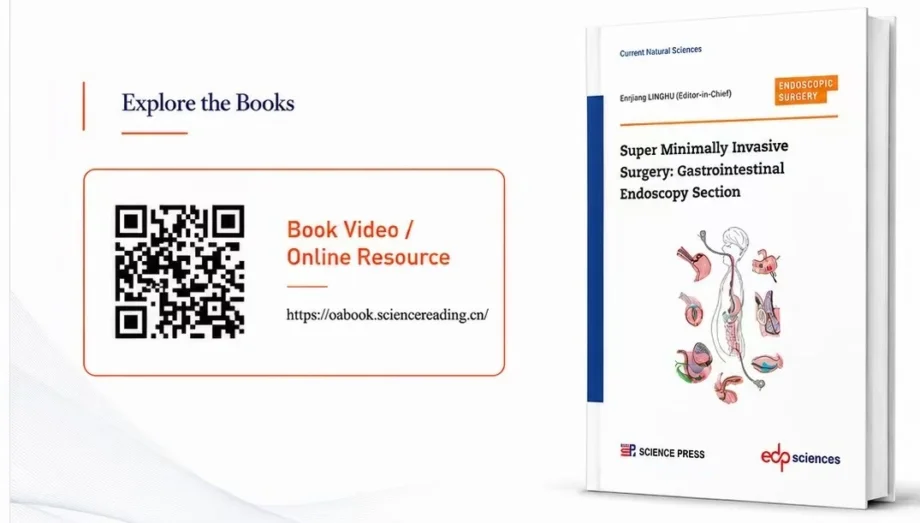
The World Endoscopy Organization is proud to celebrate the publication of Super Minimally Invasive Surgery: Gastrointestinal Endoscopy Section, a landmark new book by Professor Enqiang Linghu, a pioneering figure in third-space endoscopy and a longstanding, active member of our society. To mark the occasion, we share the Foreword by Dr. Jean-François Rey, Past President of WEO, who witnessed the origins of SMIS at first-hand:
“During my first visit to China in 2016, Professor Linghu Enqiang, reflecting deeply on the limitations of traditional surgical paradigms, pioneered the concept of super minimally invasive surgery (SMIS). As President of the World Endoscopy Organization (WEO) at the time, I had the privilege of introducing this innovative concept to the global endoscopy community through a WEO interest group. Since then, third-space endoscopy has made remarkable progress, particularly in China, by fostering close collaboration between surgeons and physicians. Under Professor Linghu Enqiang’s leadership, the Chinese Society of Digestive Endoscopy has advanced significantly through major scientific meetings and the development of innovative endoscopic procedures. This book represents an important contribution to demonstrating the benefits of digestive endoscopy for our patients and to opening new perspectives in this rapidly evolving field.”
Super Minimally Invasive Surgery: Gastrointestinal Endoscopy Section
One of medicine's greatest challenges lies in curing disease while preserving the evolutionary sophistication of the human body – a balance redefined by super minimally invasive surgery (SMIS). In this groundbreaking work, Dr. Engiang Linghu offers a comprehensive two-part exploration: a general introduction to the foundational principles of SMIS (chapters 1–7), followed by specific discussion of its clinical applications (chapters 8–14).
Part One establishes SMIS as a paradigm shift from traditional "remove-and-reconstruct " surgery to anatomy-preserving therapeutic strategies. It traces the origins of SMIS to innovations in gastrointestinal medicine and surgery, presents its four core pathways and hundreds of technical variations, and formalizes rigorous standards in terminology, instrumentation, and procedural protocols. At its heart, SMIS aims to eliminate disease while preserving organ integrity and function, protecting, for example, the body 's finely tuned pH-graded digestive "assembly line."
Part Two brings theory into practice, detailing applications of SMIS techniques to more than 40 common surgical diseases affecting the esophagus, stomach, pancreas, duodenum, colorectum, and the biliopancreatic duct system. The book highlights key advances such as organ-sparing tumor excision, functional restoration in motility disorders, and precision treatments. Beyond its technical contributions, SMIS places strong emphasis on patient-centered outcomes: reduced complications, transparent informed consent, and stringent infection control. Carefully structured with surgical standards and case documentation guidelines, this book serves as both a manifesto and a practical manual.
Acknowledging SMIS as a dynamic and evolving field, the book calls for global collaboration to advance its frontiers. It challenges surgeons to redefine success – not simply by curing disease, but by doing so without compromising the integrity of the human body. Essential reading for innovators shaping the next era of minimally invasive medicine, this work is a tribute to healing that respects nature's greatest design: the human body