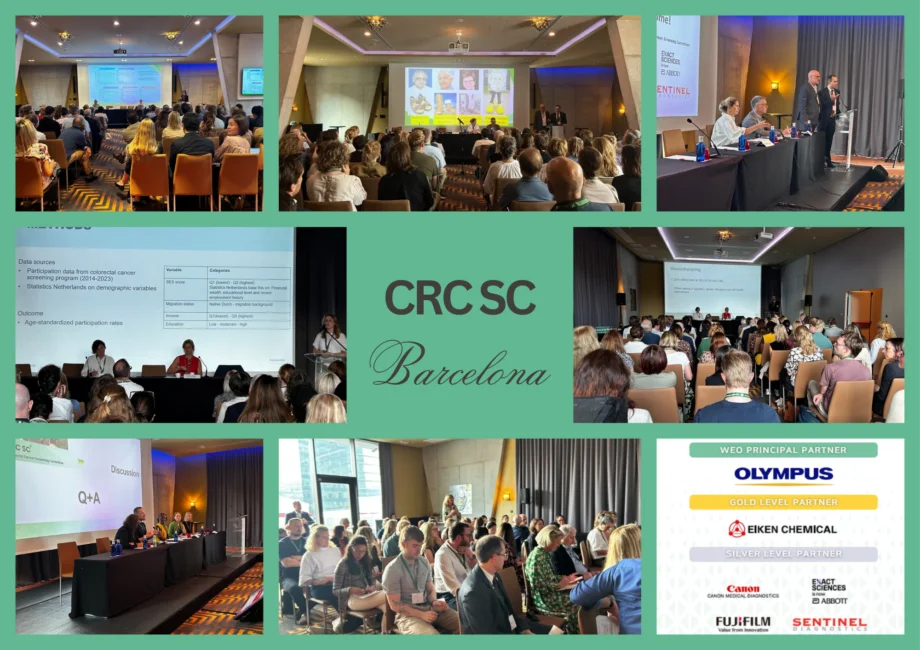
The Colorectal Cancer Screening Committee (CRC SC) of the World Endoscopy Organization held a meeting on Friday, October 16, 2026, at the Leonardo Royal Hotel Barcelona Fira. The full-day program brought together 152 participants for the Expert Working Group (EWG) sessions in the morning and the plenary meeting in the afternoon. Both were held in-person only, which encouraged open and interactive exchange. The atmosphere was highly collaborative, with lively discussions and many questions after the presentations. Many attendees stayed on after the formal program to continue the conversations with colleagues.
A new chapter for the Committee
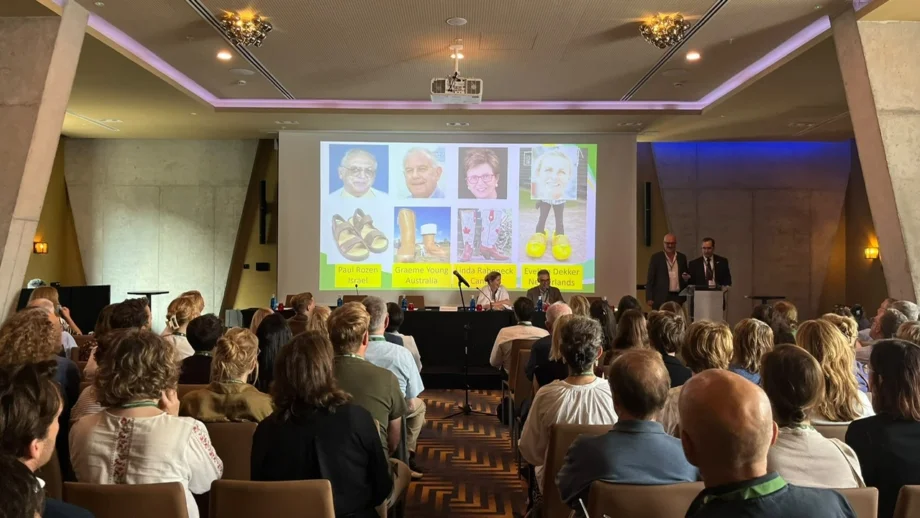
The meeting was convened by Dr. Uri Ladabaum (USA), who has taken over as Global Chair of the CRC SC, together with Dr. Rodrigo Jover (Spain), European Co-Chair. Dr. Ladabaum is happy to continue the legacy of Dr. Evelien Dekker, who led the committee as Global Chair and chaired the Surveillance after Colorectal Neoplasia EWG session in Barcelona.
Expert Working Group sessions
The morning brought together six EWGs in parallel sessions:
- FIT for Screening covered new program experiences, including the introduction of screening in the Caribbean Netherlands, an update on the Danish and Galician programs, and the challenge of keeping hemoglobin stable in high temperatures with a new fecal immunochemical test (FIT) buffer in Australia.
- PCCRC and Quality in Colonoscopy discussed an update of the 2018 WEO consensus guidance on post-colonoscopy colorectal cancer. Topics included a minimal dataset for root cause analysis and alternative methods of calculating the PCCRC rate.
- Polyp Detection, Characterization, Resection and AI featured a debate on whether computer-aided detection should be mandatory in organized screening programs. The group also discussed whether it should commit to a WEO position.
- Inequities in CRC Screening examined whether health inequalities in screening participation are widening. It also looked at unequal compliance with follow-up colonoscopy and the potential of AI to improve uptake. Evaluation of New Tests focused on the cost–effectiveness of multicancer early detection (MCED) tests and their possible integration into population screening programs.
- Surveillance after Colorectal Neoplasia discussed de-escalating post-polypectomy surveillance based on absolute cancer risk, and the role of FIT and other triage tests in surveillance.
Plenary meeting
The afternoon plenary was organized around four themes:
- Rethinking Screening Effectiveness: The NordICC Study opened the afternoon with a critical look at NordICC at 13 years, in dialogue with the trial investigators. It also addressed the role of surveillance in preventing proximal colorectal cancer and the influence of colonoscopy quality on screening trial results.
- Equity, Special Populations and Implementation presented work on inviting institutionalized persons, reaching immigrant men in FIT-based screening, and the impact of the Dutch national program on socioeconomic health inequalities.
- Rethinking Surveillance Effectiveness: The EPoS Trial and the Future of Surveillance covered lessons from the European Polyp Surveillance (EpoS) trials, adenoma detection rate (ADR) benchmarks for surveillance colonoscopy, and personalized surveillance intervals based on FIT hemoglobin concentration, cardiometabolic health, and lifestyle risk factors.
- National CRC Screening Programs in Europe featured an overview of the success of European programs and the 15 years of the Barcelona program and 25 years of the Catalan program. It also included results of the PERFECT-FIT randomized trial on risk-stratified screening, and the rationale for the Czech Republic’s change of screening age range to 45–74.
The day closed with a reception where all attendees were able to further discuss remaining questions and socialize with their colleagues.
Thank you
WEO thanks all speakers, chairs, and participants for their contributions, and the meeting’s partners for their support: Olympus, Eiken Chemical, Canon Medical Diagnostics, Exact Sciences (now Abbott), Fujifilm, and Sentinel Diagnostics.
Presentations will be made available on the CRC SC committee page.