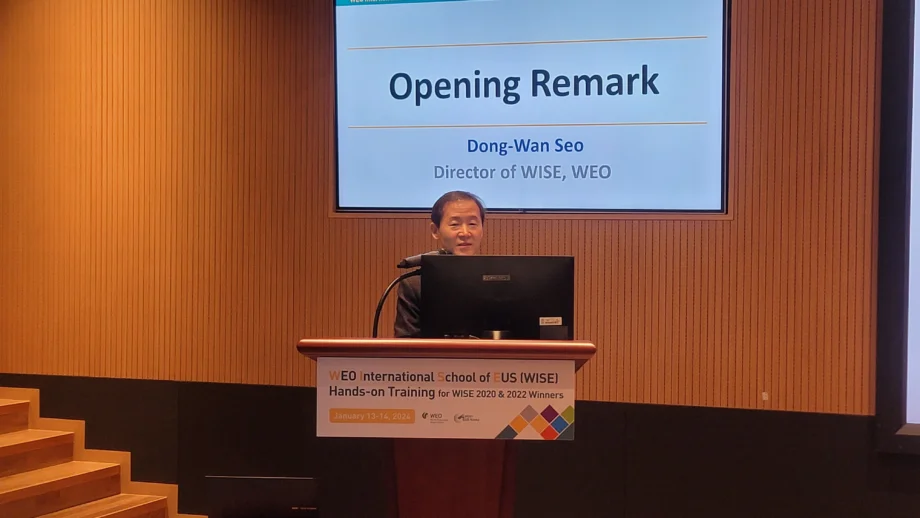
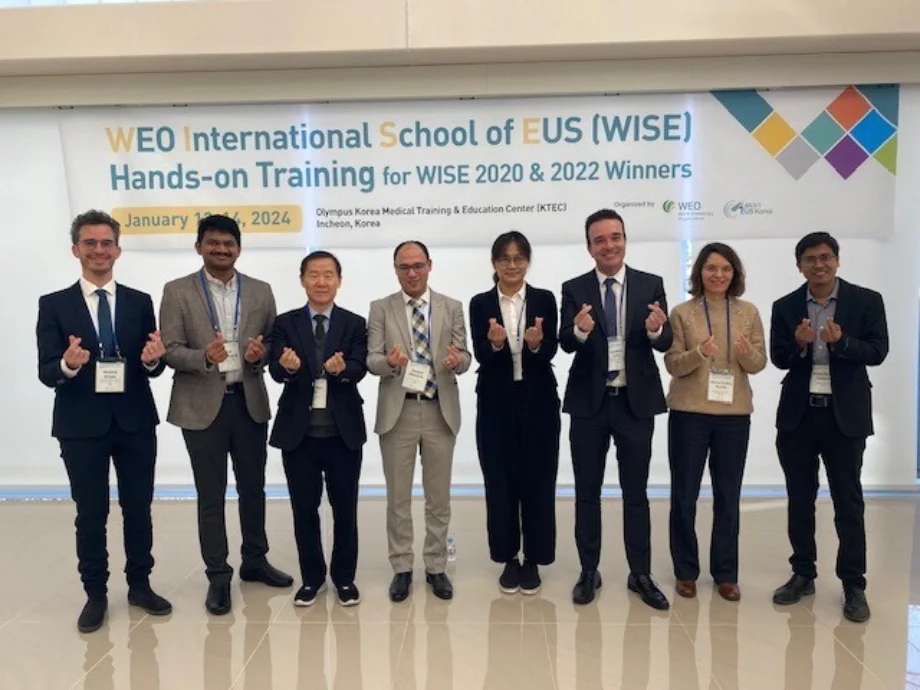
Interview with Professor Dong Wan Seo, founder and Course Director of the WEO International School of EUS (WISE)
WEO Newsletter: Could you please introduce yourself and your involvement with WEO?
Professor Dong Wan Seo: I am a Professor in the Department of Internal Medicine [at the Asan Medical Center, University of Ulsan College of Medicine, in Seoul, Korea]. As a gastroenterologist and endoscopist, my main research fields are diseases of the biliary tree and pancreas, ERCP and therapeutic endoscopy, and interventional EUS. I am also very interested in EUS education.
WEO Newsl.: Why did you decide to be part of WEO?
Prof. D.W.S.: I joined WEO as Secretary-General in 2013 after Dr. Nageshwar Reddy was promoted from Secretary-General to WEO President. At that time, I was somewhat hesitant to accept the position because I had not previously been involved with WEO. WEO is a global society covering all three zones and many individual countries, and the position was both highly prestigious and demanding.
However, with the encouragement and leadership of the Executive Committee members, I finally accepted the position of Secretary-General and completed my term until ENDO 2017, which was held in Hyderabad, India.
WEO Newsl.: The WEO International School of EUS is one of the flagship programs of WEO and highly sought-after. Why did you start WISE?
Prof. D.W.S.: When I joined WEO, there were several educational programs, such as ADEC [Advanced Diagnosis Endoscopy Course] and the CRC [Colorectal Cancer] Screening Program. However, there was no program dedicated specifically to EUS. As an endosonographer, I felt this was unfortunate, and I decided to start an EUS education program within WEO.
The concept of teaching was different from usual workshops, seminars, or meetings. Those types of programs can trigger interest in EUS but cannot guarantee continuous improvement of EUS skills because they are usually a one-time exposure. Therefore, I decided to use the term “School.”
The concept of a school includes selecting appropriate and qualified young doctors and teaching them repeatedly over a one-year period. We monitor their progress and encourage them to continuously practice EUS on their own patients. Ultimately, the goal is to help patients who are suffering.
WEO Newsl.: How has WISE developed over the years? How can participants benefit from WISE?
Prof. D.W.S.: When I first submitted this project within WEO, the Executive Committee members were concerned about the financial aspects of the project, although they agreed that the idea was good. I proposed that the program should be free of charge for participants, provided they were sincere and committed to studying hard.
Laura [Schleser-Low] and I approached several EUS and accessory companies to explain our plan and request educational grants. Fortunately, we were able to receive support from several companies and launched the project in 2018.
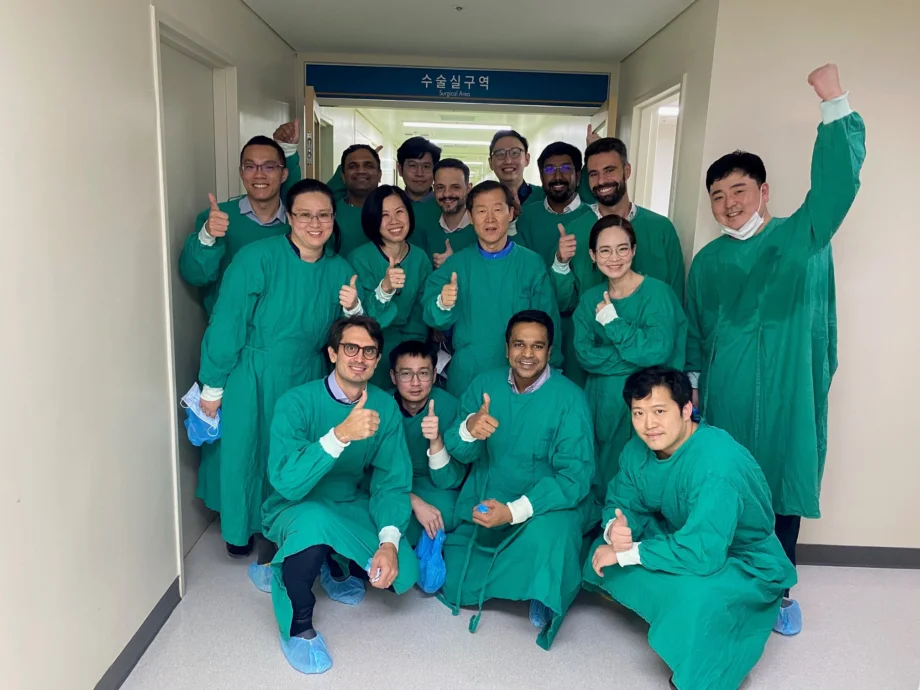
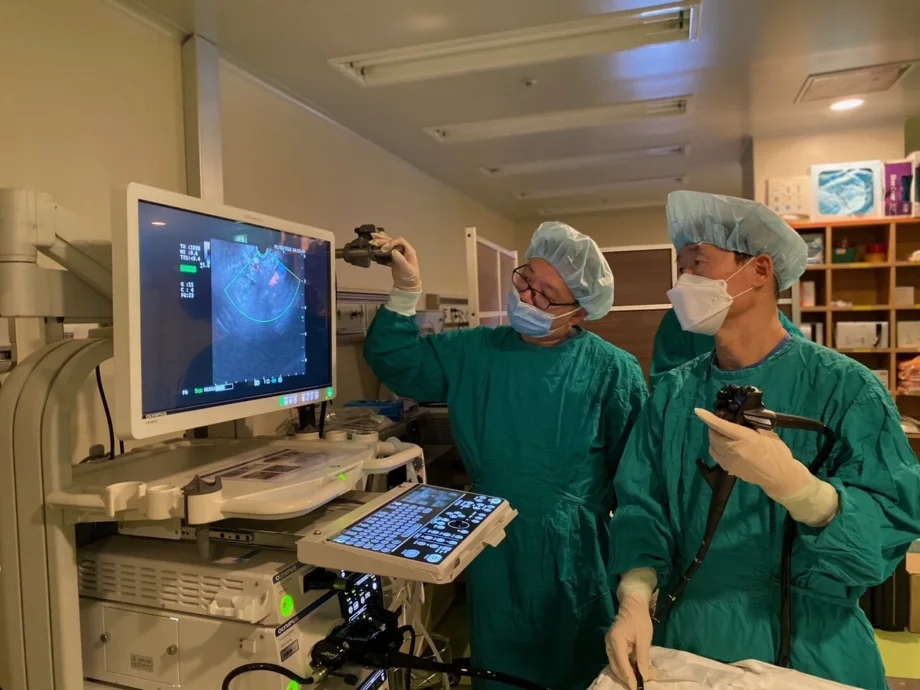
When we first started WISE in 2018, we selected just six participants and invited them to Asan Medical Center in Seoul, Korea for EUS training. The program covered the full spectrum of education, including not only lectures but also observation of real human EUS cases, ward rounds, case discussions, and hands-on training using animal models. The number of participants increased from six to nine the following year.
However, during the COVID-19 pandemic, we changed the on-site training format to an online program consisting of five different modules delivered two months apart over a one-year period. The curriculum starts with basic anatomy and delineation techniques and progresses to advanced interventional EUS. Through this structure, participants can learn the entire spectrum of EUS in a systematic way.
WEO Newsl.: What are your future plans for WISE?
Prof. D.W.S.: I would like to continue this educational program to help young doctors who do not have the opportunity to learn EUS systematically. The positive and encouraging feedback from participants has been a major driving force behind this project.
This year marks the ninth year of WISE, and we have trained 356 doctors from 54 different countries, covering most parts of the world. These trainees are forming a WEO alumni network and will become valuable assets to WEO in the future.
With the success of WISE, we have also launched the WISE Egyptian Chapter, targeting the Middle East and the northern part of Africa. Dr. Elsayed Ghoneem, who was a WISE participant in 2020, approached me and suggested establishing the WISE Egyptian Chapter to support doctors in the region. I agreed to the idea, and he has been very active and energetic in leading the program. Participants of WISE EC have greatly appreciated the program, and we have received many encouraging comments. These are the reasons why we must continue the WISE project.
WEO Newsl.: Any advice for doctors who would like to improve their EUS skills?
Prof. D.W.S.: Join WISE! It will open your eyes to various methods of improving your EUS skills. We have a diverse group of teachers from Asia, Europe, and the Americas, and their experience and practical tips can help guide you to the next level of EUS.
If I were to give some general advice:
First, learn the home base and landmark images and memorize them.
Second, try continuous tracing from the home base image. If you get lost during delineation, return to the home base and start again.
Third, review your examinations and try to edit your videos for presentation. During the review process, you will memorize landmark structures and typical pathological images.
Fourth, try to present your cases – especially difficult ones – to experts and seek their advice.
Lastly, practice and review, practice and review your EUS. This repeated approach will rapidly improve your skills.
WEO Newsl.: Please share with us your career journey so far.
Prof. D.W.S.: After graduating from Seoul National University College of Medicine in 1987, I joined the army and served for three years, taking care of elderly patients in remote rural areas. After completing my military service, I joined Asan Medical Center for my residency and fellowship training.
In 1997, I was recruited as an instructor in the Division of Gastroenterology at Asan Medical Center, University of Ulsan College of Medicine. From 2001 to 2003, I spent two years at the VA Medical Center, University of Washington in Seattle, USA, under the mentorship of Professor Sum P. Lee.
I became a full professor at Asan Medical Center in 2009 and have been involved in patient care, research, and teaching, mainly in pancreatobiliary diseases, ERCP, and EUS.
WEO Newsl.: You are an inspiration to many young doctors. Who inspires you?
Prof. D.W.S.: I have been influenced by several great masters. Professor Nib Soehendra taught me creativity, humility, and a warm heart. I learned delicate EUS delineation skills from Professor Kenjiro Yasuda, and I was very impressed by his friendliness, even though he was already an iconic figure when I was still young.
Professor Robert Hawes taught me how to present effectively on the international stage. Lastly, my father taught me sincerity and diligence.
WEO Newsl.: You are involved in many conferences and educational programs outside of your usual duties. How do you balance the demands?
Prof. D.W.S.: It is quite challenging. Most of my trips are within Asia, and I usually travel on weekends so that they do not interfere with my hospital duties. However, I still do not have much time to spend with my family, and I feel sorry about that.
It is important to use time wisely and efficiently. Nowadays, I am gradually reducing my trips abroad to compensate for the time I have spent away from my family.