Outreach session with the Asian-Pacific Society for Digestive Endoscopy (A-PSDE)
December 30, 2025
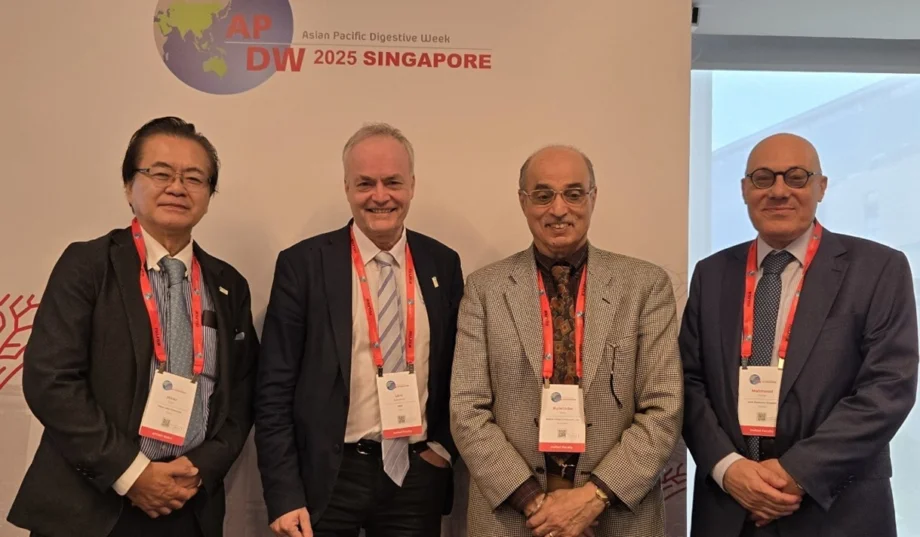
The APSDE-WEO Outreach Session: “Endoscopy Training in Underserved Regions: Making a Difference” took place on November 19 during APDW 2025 in Singapore. Four speakers from around the world shared their knowledge, experience, and perspectives, and the session was moderated by Drs. Lars Aabakken, Hisao Tajiri, and Kulwinder Dua.
Endoscopy training takes place around the world but is offered in different ways. This partly reflects local requirements, but also cultural and local traditions. This session aimed to highlight these differences and help us to better understand how training can be improved and, hopefully, standardized, especially as more endoscopists move between countries.
The first speaker, Dr. Nonthalee Pausawasdi from Thailand, presented on “Endoscopy Without Borders: Bridging the Gap as a Trainer.” She emphasized that bridging educational gaps requires competency-based standards tailored to local contexts, the strategic use of technology, and the development of both trainers and training systems. She outlined several key opportunities to advance this goal:
1 Digital technology: Utilizing online platforms and e-learning resources to expand access and standardize training.
2 Innovative teaching methods: Implementing blended learning models that combine face-to-face instruction with virtual participation.
3 Regional collaboration: Strengthening cooperation among Southeast Asian countries through national and international societies to share expertise and resources, while also fostering wider international partnerships with global organizations.
Dr. Mahmoud Omar from Kuwait presented on “Addressing Global Research: Challenges in Underserved Regions.” Lack of leadership, and also of political interest in health research, mentoring, funding, infrastructure, and industry support, were discussed as some of the major issues related to conducting research in underserved regions of the world. Other challenges include knowledge gaps in research design, analysis, and writing. Similarly, many centers do not have a formal ethical committee and there is lack of trust among participants. The successful role of international organizations such as the WEO Outreach Committee in training and collaborating in research with underserved regions of the world was discussed and there was optimism that these associations can address many of these issues.
Dr. Majidah Bukhari from Dubai delivered a presentation entitled “Breaking Barriers: Women Shaping Endoscopy in the Middle East.” She called for action to build bridges toward a stronger and more equitable future for women in endoscopy. Supported by WEO, she has formed the ELEGANCE society (Endoscopy Ladies Empower Growth And Networking across the Middle East), and extended an invitation to leaders in GI endoscopy across both the East and the West to join them in fostering a more inclusive future for women in endoscopy, so that women will equally shape global standards and practice in endoscopy. The ELEGANCE society is already up and running with several members and has already successfully conducted three international conferences.
Finally, Dr. Kulwinder Dua presented on “Zooming into the GI Tract: Remote Training in Real Time.” From learning basic endoscopy procedures to upskilling and learning new techniques, remote training has the advantage of reduced need for travel, the ability for trainers and mentors to teach within their own clinical environment, and increased flexibility and choice in training opportunities by tapping into experts from around the world. However, some period of in-person hands-on training is recommended prior to remote training. He also highlighted several limitations of remote training. These include concerns regarding patient safety, the need for reliable and high-speed internet connectivity, and legal considerations such as licensure to practice across borders, malpractice insurance, and patient consent and related ethical issues. Many of these could be addressed if training can also be provided using virtual reality and augmented virtual reality where no patient interaction is needed.
The presentations were followed by a lively question-and-answer session. Lars Aabakken summarized that all the presentations were significant because of the concrete way they brought to life current situations and issues.