Location: Nairobi, Kenya
Dates: March 2–4, 2026
Author: Dr. Saurabh Mukewar, WEO Outreach Committee Tutor
A successful training course was held at the Kenyatta Hospital in Nairobi, attended by approximately 30 gastroenterologists from the Kenyatta Hospital and the wider Nairobi area. The course featured a comprehensive curriculum of didactic lectures and live demonstrations, fostering an environment of active learning and professional exchange.
On the first day, the workshop began by covering basic instruments and essential techniques for ERCP. This was followed by a focus on specialized maneuvering on the bile duct after failed cannulation. During this time, there was active interaction with local clinicians to discuss specific challenges they face in their daily practice. The day concluded with two live demonstrations of complex ERCP cases, utilizing the hospital’s available equipment.
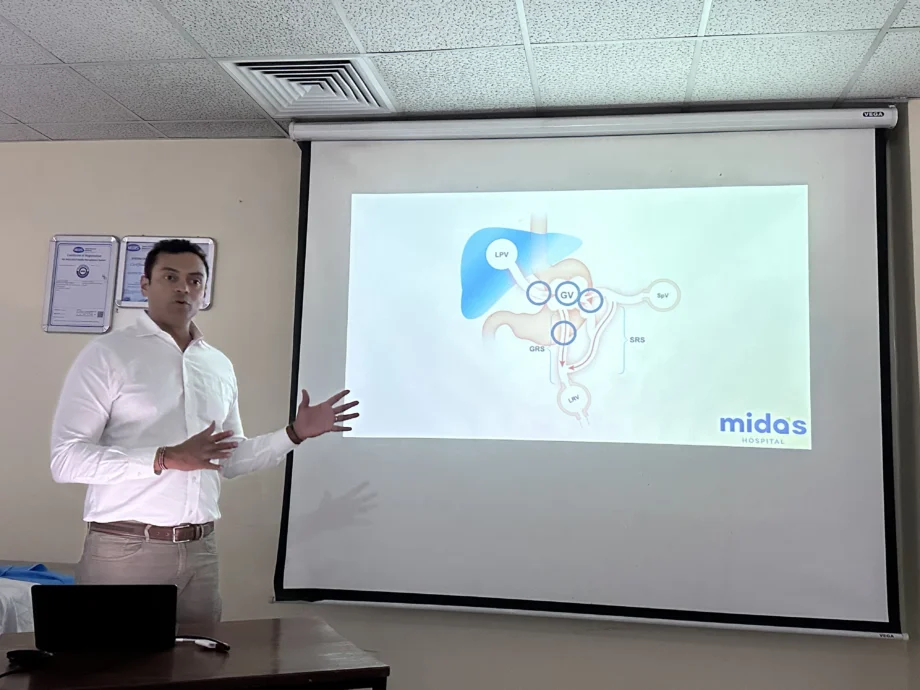
The next day, local doctors from the Nairobi Gastro Center provided insights into a structured approach for upper endoscopy examination, Helicobacter pylori eradication regimes in 2026, and endoscopic features of H. pylori infection. There was fruitful discussion during the event on appropriate endoscopy technique and management of H. pylori, which was beneficial for me personally as well as the audience. I contributed sessions on management of gastric varices, highlighting the latest approaches including several EUS-guided methods. I also gave a talk on identification and management of gastric polyps, a scenario frequently encountered by trainees, which prompted a lot of discussion.
Following this, a range of procedures was, performed with a high degree of trainee involvement. The first case was of standard ERCP with biliary cannulation. I demonstrated all the steps from advancing the endoscope to performing biliary cannulation. Additionally, trainees were given the opportunity to intubate the upper esophageal sphincter with the side-viewing scope and to practice advancement of the scope into the duodenum under supervision. This was followed by peroral endoscopic myotomy (POEM) cases, more advanced for the trainees but providing them with a great opportunity to observe performance of an advanced third-space endoscopy procedure. The first case, allowed me to fully and effectively demonstrate all the steps of POEM. The second POEM case allowed me to not only demonstrate but also to help local gastroenterologists carry out key steps of the procedure under my guidance, which would enhance their technical confidence in performing this technique independently in the future. Following this, we undertook another general ERCP case. Again, it gave an opportunity to help the fellows practice the use of the side-viewing scope under supervision.
Additionally, we also conducted a few cases of colonoscopy with polypectomy. I supervised the fellows in assessment of the polyps and classification using various systems such as Paris and JNET. The fellows additionally performed cold snare and hot snare polypectomies, under my supervision and guidance regarding the optimal techniques. We also carried out a dilation of a benign duodenal stricture.
The final day began with a lecture by Dr. Stephen Onyango on withdrawal technique in colonoscopy. This highlighted the importance of careful examination during withdrawal to ensure appropriate polyp detection. I followed this with a discussion on image-enhanced endoscopy in colonic lesions, where we considered in depth the various classification systems for colonic polyps, with illustrative examples. This was well received by local doctors. I additionally gave talk on endoscopic submucosal dissection, including explanation of traction and closure techniques with several video illustrations.
The clinical sessions featured two POEM cases. The first was a highly complex “sigmoid esophagus” in a young patient. The procedure was primarily performed by me, given the challenging nature of the case, and enabled demonstration and explanation of the challenges encountered while performing complex POEM interventions. I highlighted the importance of ensuring that the tunnel direction is appropriate, and that suitable care is taken to prevent mucosotomy. Fortunately, the procedure went very well and was successful. The final case was another routine POEM, a collaborative effort where the consultant gastroenterologist assisted with closure of the mucosal defect.
The event gave a good overview of the POEM technique, and it was characterized by the considerable enthusiasm of all participants and the quality of the hospital equipment. The nursing and doctor teams showed significant growth over the three-day event, becoming increasingly proficient with the specialized accessories required for third-space endoscopy. I believe the variety of cases demonstrated provided a robust overview of modern gastroenterology. The hands-on experience boosted the confidence of the local teams in performing these advanced procedures independently.
This report was prepared by Dr. Saurabh Mukewar, interventional gastroenterologist, hepatologist, and WEO Tutor.
The World Endoscopy Organization would like to sincerely thank Olympus and Micro-Tech for their invaluable support of this educational program and for their continuing contributions to advancing gastroenterology services across Africa.